
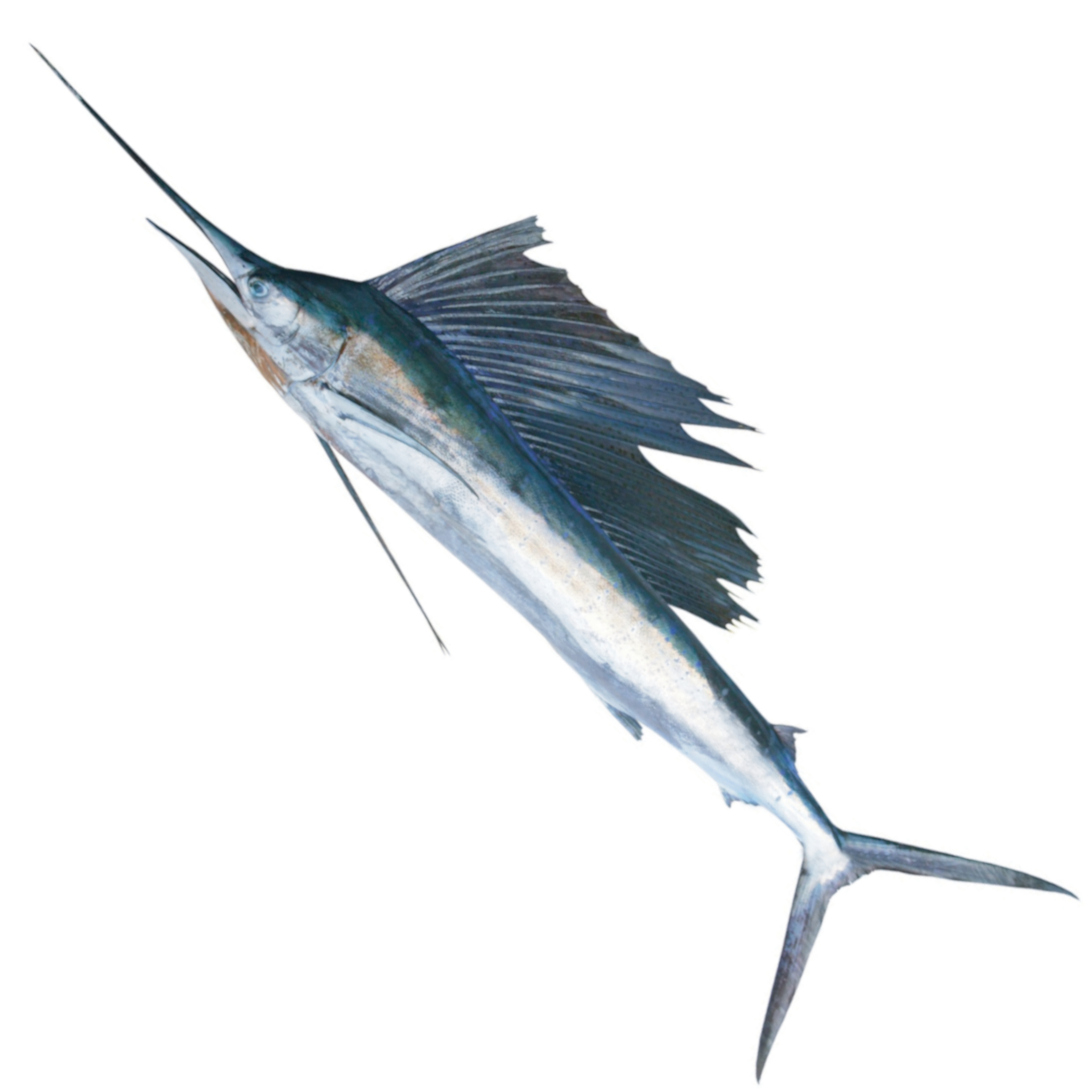
Sailfish (Istiophorus platypterus) are among the fastest and most agile predatory fish in the ocean, easily recognized by their long, slender bodies, distinctive sail-like dorsal fins, and elongated, pointed bills. Their bodies are built for speed, with a bluish back, silvery-white underside, and streamlined shape that reduces water resistance. These adaptations allow sailfish to reach bursts of speed up to 110 kilometers per hour, making them incredibly effective hunters. The large, sail-like dorsal fin can be raised or lowered, helping them maneuver while hunting or herding schools of smaller fish.
Sailfish are widely distributed in tropical and subtropical oceans around the world, including the Atlantic, Indian, and Pacific Oceans. They generally inhabit the surface and near-surface waters of open seas, often traveling long distances in search of prey. Their diet consists mainly of small fish, such as sardines and mackerels, as well as squid. Sailfish use their speed and bills to slash or stun prey, allowing them to capture food efficiently.
Besides their ecological role as top predators, sailfish are highly valued in sport fishing for their impressive speed, strength, and acrobatic leaps when hooked. While they are not typically consumed on a large commercial scale, their popularity among anglers has made them an iconic species in recreational fishing. Sailfish are a striking example of the evolutionary adaptations that enable marine predators to thrive in open-ocean environments, combining speed, agility, and specialized anatomy to dominate their habitat.
Reviews
There are no reviews yet.